The Benefits Of Risky Play In Early Years Education
Risky play can sound worrying to parents, but in early childhood education, it does not mean careless or unsafe play. It means giving children age-appropriate opportunities to climb, balance, jump, explore, make decisions, and test their abilities with guidance from qualified educators.
This article explains what risky play means, why it matters in early childhood, and how educators can support adventurous play in a childcare setting.
What Is Risky Play In Early Childhood?
Risky play is play that includes challenge, uncertainty, movement, height, speed, or problem-solving. It is the kind of play where children may think, “Can I climb a little higher?”, “Can I balance across this log?”, or “Can I jump from here safely?”
This does not mean children are left to manage unsafe situations alone. In early childhood education, risky play should be planned, supervised, and suitable for the child’s age, confidence, and development.
Ellen Sandseter, a Norwegian Professor of Physical Education and Health within Early Childhood Research, has identified six categories of risks that seem to attract children everywhere in their daily play:
Great Heights: Children climb trees and other structures to scary heights, from which they gain a bird's-eye view of the world and the thrilling feeling of accomplishment!
Rapid Speeds: Children enjoy swinging on the playground swings; sliding down the slide and riding bikes and scooters at incredible pace; this produces the thrill of almost but not quite losing control.
Dangerous Tools: Depending on culture, religion, and home life, children play with bows and arrows, farm machinery (where work and play combine), hammers and nails, or other tools which could potentially be dangerous. Children also get great satisfaction in being trusted to handle such tools, but there is also a thrill in controlling them, knowing that a mistake could hurt.
Dangerous Elements: Children love to play with fire, or in and around deep bodies of water, either of which poses some danger.
Rough And Tumble: Children everywhere chase one another around and fight playfully, and they typically prefer being in the most vulnerable position - the one being chased or the one underneath in wrestling–the position that involves the most risk of being hurt and requires the most skill to overcome.
Disappearing/Getting Lost: Little children play hide and seek and experience the thrill of temporary, scary separation from their companions. Older ones venture off, on their own, away from adults, into territories that to them are new and filled with imagined dangers, including the danger of getting lost.

Why Risky Play Is Not The Same As Unsafe Play
Understanding different risky play types can help parents identify which is risky and beneficial for learning and which is not.
Risky play is not about pushing children beyond their abilities. Child Australia explains that risky play is not about placing children outside what they can manage, but about allowing thrill, excitement, and physical challenge to be included in early childhood environments.
Unsafe play might involve broken equipment, poor supervision, inappropriate heights, sharp edges, dangerous materials, or environments that are not suitable for a child’s age. Risky play, when managed well, is different. It happens in spaces where educators are present, equipment is checked, children are observed, and support is offered when needed.
What matters is the goal, which is to help them learn how to notice their surroundings, understand their body, ask for help, and try again with care.
How Risky Play Supports Children’s Development
Risky play supports children across physical, emotional, social, and cognitive development. These benefits often happen through simple everyday moments, such as climbing one step higher, balancing for a few seconds longer, or deciding whether they are ready to try again.
Building Physical Confidence
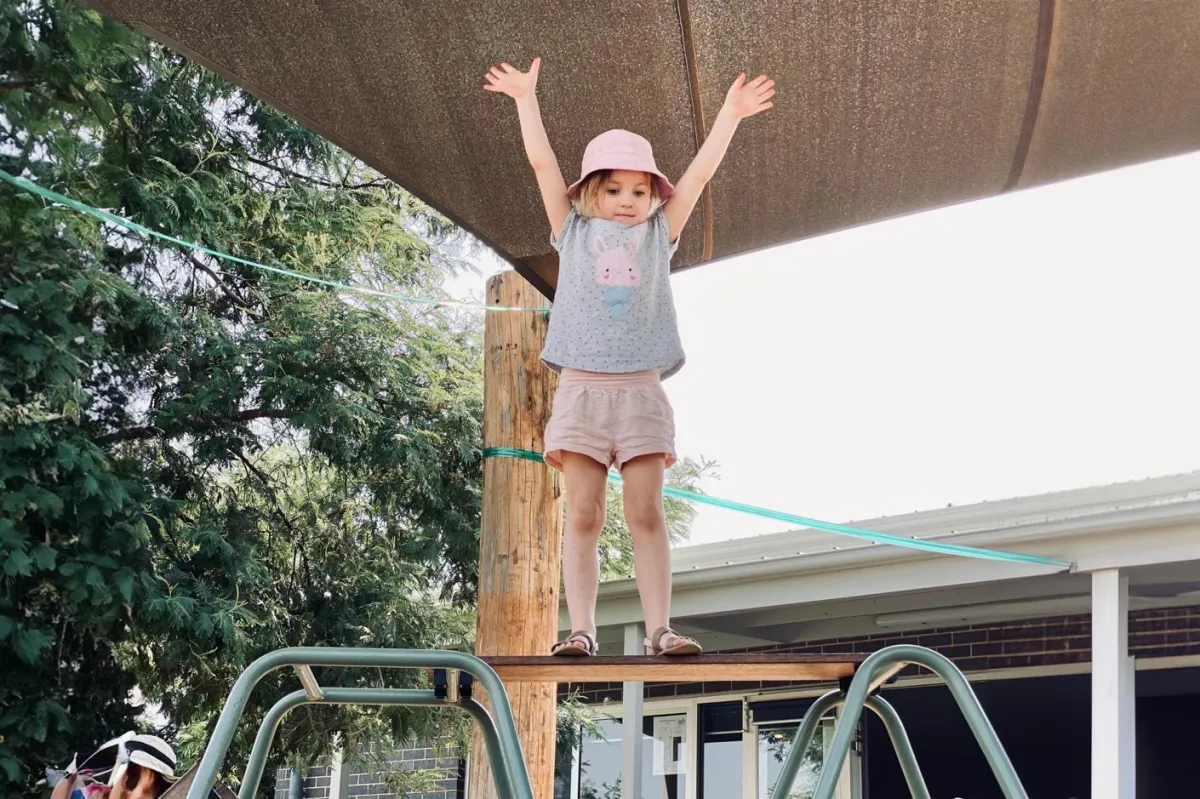
Physical confidence develops when children have safe opportunities to try movements that feel slightly challenging. Climbing a low structure, stepping across uneven ground, jumping from a safe height, or balancing on a beam can help children understand what their bodies are capable of.
For example, a child who climbs a low platform may feel unsure at first. With an educator nearby, they can pause, look for a handhold, decide where to place their feet, and try again at their own pace. When they complete the movement, they begin to feel more capable and willing to try similar challenges in the future.
This kind of confidence does not come from being pushed. It grows when children are given enough time, space, and support to practise manageable challenges safely.
Improving Coordination And Body Control
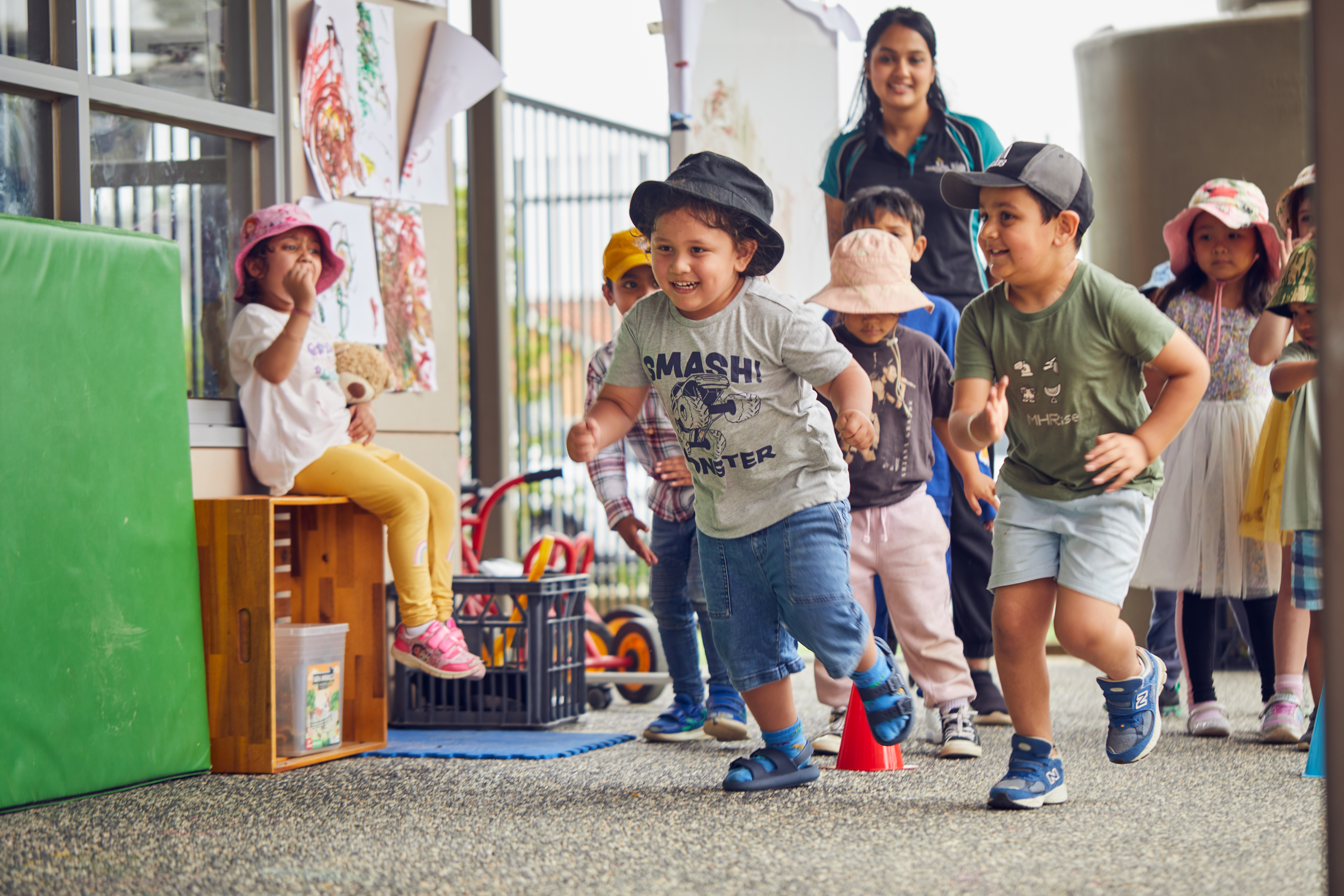
Coordination develops when children learn how to use different parts of the body together. In risky play, this may happen when a child balances across stepping stones, crawls through a tunnel, carries loose parts, climbs, runs, jumps, or changes direction during outdoor play.
These movements require children to plan what comes next. They may need to look ahead, adjust their speed, grip with their hands, bend their knees, steady their body, or move around another child. Over time, these repeated experiences support balance, spatial awareness, strength, and body control.
This is why age-appropriate risky play is valuable in early childhood. It gives children practical movement experiences that help them build confidence and coordination in real situations, not only through structured exercises.
Supporting Problem-Solving And Decision-Making
Risky play gives children real chances to make decisions. They may need to work out whether a branch is too high, whether a block tower is stable, whether they need help, or whether they should try a different way.
This kind of thinking supports early problem-solving. Children begin to ask themselves: “Is this safe for me?” or “What should I do next?” These decisions help children practise thinking before acting and noticing the relationship between their choices and outcomes.
Helping Children Build Resilience
Risky play often includes moments of trial and error. A child may not climb the first time successfully. They may lose balance, step down, pause, or ask for help. These moments can help children learn that it is okay to try, stop, think, and try again.
Resilience does not come from never feeling challenged. It develops when children meet manageable challenges with support.
Educators can help by using calm, encouraging language such as: “Take your time.”; “Where will your foot go next?” or “Would you like to try another way?” This kind of support helps children feel safe while still allowing them to take part in the challenge.
Developing Risk Awareness
One of the most important benefits of risky play is that children begin learning how to assess risk for themselves. This does not mean adults hand over responsibility for safety. It means children are gently guided to notice what is happening around them.
For example, an educator might ask “Is the ground wet or dry?”; “How high are you comfortable climbing?” or “Where can you hold on?”. These questions help children slow down and think. Instead of only hearing “be careful,” children are given specific guidance that helps them understand what to look for.
Over time, children can become more aware of their body, other children, equipment, surfaces, and movement. This can support safer, more thoughtful participation in play.
Encouraging Independence And Confidence
When children are trusted to try age-appropriate challenges, they often feel proud of what they can do. They may say, “I did it,” “I climbed by myself,” or “I was brave.”
This confidence matters. It helps children see themselves as capable. It also supports independence because children learn to make choices, solve small problems, and take part in routines without needing adults to direct every step.
Supporting Social Development During Play
Risky play can also support social awareness because children are often moving, climbing, balancing, or building near one another. In these moments, they begin to notice that their actions can affect other children’s safety and comfort.
For example, a child climbing on playground equipment may learn to check whether another child is below before jumping. A child carrying loose parts may need to slow down when walking past others. A child who notices a wobbly block structure may tell a friend, “Wait, it might fall,” or ask an educator for help.
These moments help children practise communication in a real situation. They are not only learning how to take turns. They are learning how to look around, speak up, listen to warnings, and respond when another child needs space or support.
Educators can guide this by using simple prompts such as, “Who is near you?”, “Is there enough space?”, or “How can we let your friend know?” Over time, children begin to understand that safe play is something they practise together, not only something adults manage for them.
What Parents Should Look For During A Childcare Centre Tour
When visiting an early learning centre, parents can ask how the centre supports risky play during outdoor routines, movement activities, and child-led exploration. A good centre should not remove every challenge, but it should show clear supervision, safe environments, and thoughtful educator guidance.
Parents may also ask questions during the tour, such as:
How do educators decide which risky play activities are suitable for each age group?
How are outdoor play spaces checked before children use them?
How do educators support children who feel unsure about climbing, balancing, or trying new physical challenges?
How do educators help children understand safety without making them afraid to explore?
How does the centre communicate with families about outdoor play and active learning?
How Risky Play Is Implemented Here At Inspira Kids
Educators play an important role in helping children experience challenges without being placed in unsafe situations. In Inspira Kids, we support our students in many ways:
Loose parts play – we provide our children with items such as plastic PVC pipes, milk crates, large wooden cable reels, ropes, pulleys, and wooden boxes.
Cooking experiences where children are allowed to use sharp “child-friendly” knives to prepare foods.
Allowing children the opportunity to climb, jump and challenge their unique individual physical skills.
Using climbing apparatus in non-traditional ways such as climbing up the slide or going down head first, not feet first!
Kinder excursions where children and educators explore the wonderful resources which nature provides.
Supporting children to problem solve and make decisions.
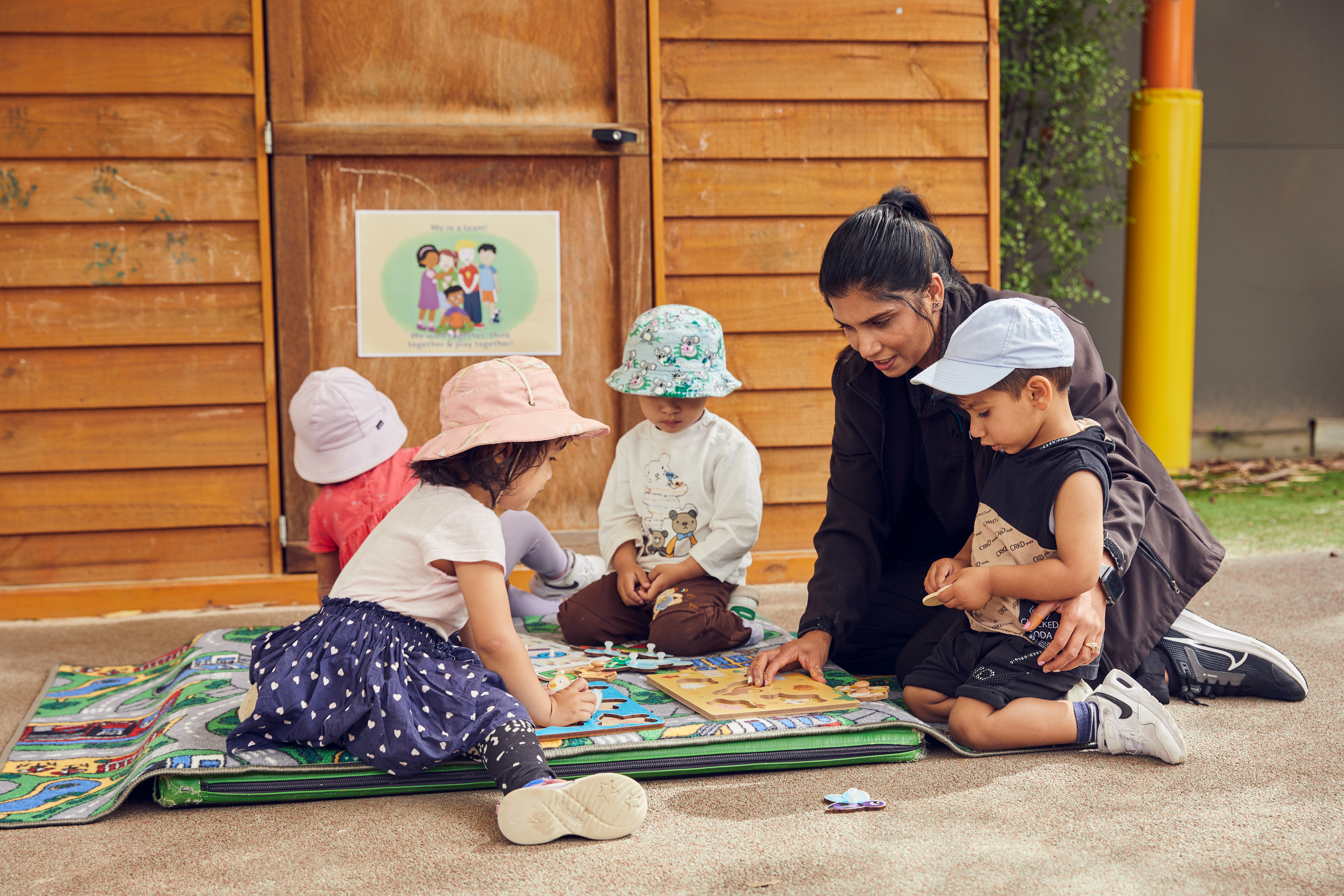
A helpful educator does not always need to lift a child down immediately or stop every challenging moment. Sometimes, the best support is to stay nearby and guide the child with a question.
How Parents Can Support Healthy Risky Play At Home
Parents can support safe, age-appropriate risky play at home, in the backyard, or at local parks. The aim is not to create dangerous situations, but to give children manageable challenges where they can practise movement, judgement, and confidence with adult guidance nearby.
Choose Safe Challenges That Match Your Child’s Ability
Healthy risky play works best when the challenge is suitable for the child’s age, confidence, and physical ability. This might include climbing suitable playground equipment, balancing on a low log, stepping across safe stones, or jumping from a low surface.
The activity should feel slightly challenging, but not unsafe or overwhelming. Parents can stay close, observe how the child is managing, and offer support without immediately taking over. This helps children learn what their bodies can do while still feeling secure.
Use Specific Guidance Instead Of Only Saying “Be Careful”
Children may not always understand what “be careful” means. More specific guidance helps them notice the real risk and make better decisions.
For example, parents might say, “Hold on with both hands,” “Look where your feet will land,” or “Wait until there is space before you jump.” These prompts teach children what to pay attention to, rather than simply stopping the play.
Over time, this helps children build risk awareness. They begin to look, pause, think, and adjust their movement more confidently.
Give Children Time To Try Before Stepping In
It can be tempting to help children immediately when they are climbing, balancing, carrying, or solving a physical challenge. However, giving them a little time to try can support independence and problem-solving.
If a child is working out how to climb down from a low platform, the adult can stay nearby and calmly guide them with questions such as, “Where could your foot go next?” or “Can you turn your body slowly?” This allows the child to think through the movement instead of relying on an adult to solve it for them.
The goal is not to leave children unsupported. It is to offer enough space for them to practise, while still being close enough to keep the experience safe and reassuring.
Supporting Risky Play At Inspira Kids
At Inspira Kids, risky play is supported through educator guidance, safe supervision, and thoughtfully prepared learning environments. Children are encouraged to move, explore, test their abilities, and build confidence through age-appropriate challenges.
This connects closely with Inspira Kids’ Reggio Emilia-inspired approach. In a Reggio-inspired environment, children are seen as capable learners who can make choices, ask questions, and explore their own ideas with the right support around them. Risky play gives children space to do this through movement, problem-solving, and hands-on discovery.
Educators play an important role in making these experiences safe and purposeful. They observe each child’s confidence, prepare suitable spaces, remove hazards, and guide children with calm prompts such as “Where will your foot go next?” or “Do you feel steady?” This helps children think about their movements instead of relying only on adult instructions.
When risky play is supported with care, children can build confidence, body awareness, decision-making, and independence. To see how Inspira Kids supports children through Reggio-inspired environments, active outdoor play, and development-focused care, book a tour at your nearest Inspira Kids centre.