Our Insights
Understanding Your Child Better
Our Insights
Understanding Your Child Better
Our Blog

Earth Day Activities For Preschoolers: Simple Ways To Help Children Learn How To Belong
Earth Day Activities For Preschoolers: Simple Ways To Help Children Learn How To Belong
People might think Earth Day is about big lectures on climate change, but for preschoolers, it starts with falling in love with the world right outside the door.
These small moments help children feel connected to nature and show them that every small action can lead to a big change. By keeping activities simple, we help them learn how to stay clean, save water or take care of personal belongings.
What Does Earth Day Mean For Preschoolers?
At the early years of learning, children begin learning about the environment by participating in watering a plant or picking up trash. This simple activity helps them develop a sense of belonging, knowing that every action can lead to a greater outcome.
Learning about Earth Day falls into the Being pillar - understanding the concept of living in the here and now. Therefore, a simple recycling game, a nature walk, or planting seeds can be more meaningful than a long explanation.

Top 5 Earth Day Activities For Preschoolers
Earth Day activities for preschoolers should stay practical and child-friendly. When children are invited to join simple routines and hands-on experiences, they are more likely to understand the idea behind the activity.
Here are some games that foster relationships with nature that are easy to play and apply in your classes.
Recycling Sort Game
A recycling sort game is one of the easiest ways to introduce Earth Day ideas in a clear and visual way. Set up a few bins or containers with simple labels, then invite children to sort clean everyday items into the correct group. If needed, you can use pictures to show what belongs where.
You will need clean recyclable items, labelled bins or containers, and picture cards if the children need extra support. It helps to keep the categories simple at first so the activity does not become confusing. Modelling one or two examples before the children begin can also make it easier for them to join in.
This activity supports basic recycling awareness, sorting skills, observation, and simple environmental responsibility. This game can be done every day as a habit, helping children form habits and train children's thinking about arranging things neatly.
Planting Seeds Activity
Planting seeds is a practical way to help preschoolers connect with living things. Children can plant seeds in small pots, garden beds, or recycled containers, then take turns watering them over time.
You will need seeds, soil, pots or garden space, and a watering can. Fast-growing plants can help keep children engaged, especially if you want them to notice change more quickly. It also works well to pair this activity with simple conversations about caring for plants and what they need to grow.
Planting supports patience, care routines, connection with nature, and early understanding of growth. It also helps children see that caring can have visible results over time.
Nature Walk And Clean-Up Spotting
A supervised nature walk can help children slow down, observe, and talk about what belongs in outdoor spaces. During the walk, you can encourage them to notice plants, animals, trees, flowers, and any rubbish that does not belong. This will stimulate children's curiosity as well as be an opportunity for you to introduce them to new surrounding objects, stimulating them to communicate and ask questions about them.
This activity can be organised in an outdoor area at the centre, in a garden, or during a short local walk. Some materials include:
A pack of gloves, a rubbish bag, and picking tools like grabbers.
A simple checklist of things children can collect along the trip.
To help children learn effectively, try to use easy-to-understand words, and avoid mentioning big issues like climate change or the greenhouse effect. What you need to do is let children remember goals that are useful to them at that moment so they can remember easily, for example, littering will make the surrounding air fresher or cleaning dry tree branches in the garden will help children avoid danger when playing.
Recycled Art Collage
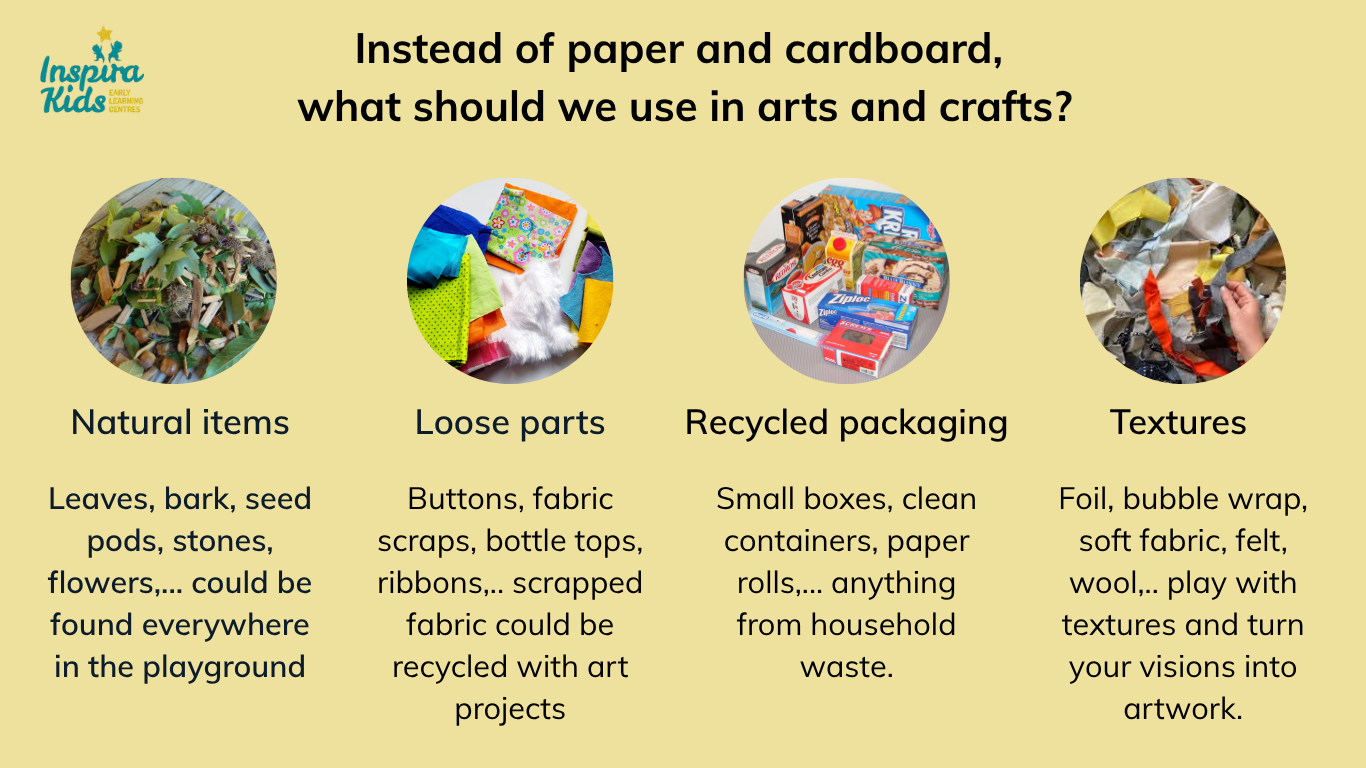
Recycled art collage gives children a creative way to reuse. Invite them to make an Earth-themed picture or design using clean recycled materials such as cardboard, paper scraps, old magazines, or packaging. This is also the best way to conduct sustainability in childcare.
You will need a base such as cardboard or paper, a selection of clean recycled materials, glue, and scissors, while tearing paper with hands is advisable. Pre-sorting the materials can make the activity easier and safer to manage. You can give keywords about a topic to stimulate children's creativity, for example, an animal, an object or a flower, this will make it much easier for children to do.
This kind of collage supports creativity, reuse awareness, fine motor skills, and self-expression. It also helps children see that everyday materials can be used in new ways instead of being thrown away.
Energy Saving Role Play
Energy saving role play is a simple way to connect Earth Day ideas to familiar routines. You can create pretend or real situations around turning off the faucet after washing hands, turning off electrical appliances when leaving the room and guide children to think about using only what they need.
This can be organised with a play sink setup, or the light source. It works especially well when linked to classroom or home routines so the message feels practical rather than separate from daily life.
Tips for educators: demonstrate different energy sources, including renewable ones such as sunlight, wind, or water. From this, educators can ask follow up questions, letting them find out more about these energy sources.
Helping Children Build Care Through Everyday Experiences
Earth Day can be a useful reminder that young children learn a lot through small, repeated experiences. It helps children build connections with the world around them, develop respectful habits, and take part in shared environments with more awareness.
At Inspira Kids, we see every activity as a chance to nurture the Body, Mind, and Character. By keeping learning practical, Earth Day is not an unfamiliar topic in books, rather it lives and surrounds children, reminding them the joy of just being in the present.