Sustainability in childcare may sound out of touch for some people. Instead of recycling paper or turning off taps solely, introducing a sustainable lifestyle to childcare is about helping children build lifelong habits of care, responsibility, and respect for the world around them.
In Australian early learning settings, sustainability is embedded in everyday routines and aligned with the Early Years Learning Framework (EYLF) and national quality standards. In this guide, we explore what sustainability in childcare really means, why it matters for young children, and five simple, practical ways educators can bring sustainability to the classroom, helping parents choose services that align with their eco-conscious values.
Sustainability in childcare means teaching children to care for their environment through everyday actions, routines, and experiences.
In early learning settings, sustainability is woven into daily practices: how materials are used, how resources are conserved, and how children are encouraged to respect the world around them.
In Australia, sustainability is embedded within the Early Years Learning Framework (EYLF), particularly under Outcome 2: Children Are Connected With And Contribute To Their World. According to the framework, teaching sustainability in childcare means helping children acknowledge their positions in the cooperative relationship with the surrounding environment, including social, economic, and environmental sustainability.
It is also reflected in the National Quality Standard (NQS), overseen by ACECQA (Australian Children’s Education & Care Quality Authority), which highlights environmentally responsible practices as part of quality education and care.
When we talk about sustainability in childcare, we are talking about:
Teaching children to reduce waste
Encouraging water and energy conservation
Making thoughtful material choices
Introducing nature-based learning
Building lifelong habits of environmental responsibility.

Young children are naturally curious and observant. When sustainable practices are part of their daily environment, they absorb these habits as “normal”. According to ELYF, weaving sustainable activities helps children develop the three main goals: belonging, being, and becoming. It focuses on small, meaningful actions children can understand and participate in.
While sustainability may have different dimensions that require different approaches, sustainable lectures in childcare mainly focus on the environmental one, whereas children have opportunities to become socially responsible and show respect for the environment.
Early exposure helps children:
Develop responsibility and empathy
Understand cause and effect
Build problem-solving skills
Connect with nature
Form lifelong eco-conscious habits
To subtly introduce sustainable practices into childcare, educators should put in mind 7Rs that are applied to effectively implement sustainability: reduce, reuse, recycle, respect, repair, reflect and refuse.
Here are five simple, effective ways sustainability in childcare can be implemented in classrooms.
One of the most effective sustainability strategies is reducing waste through reuse. Teaching children may include using a lot of resources, instead of discarding materials, educators can repurpose:
Cardboard boxes
One-sided paper
Scrap paper
Shredded paper
Bottle tops
Packaging materials
These items become valuable tools for creative play, STEM activities, and craft projects. This teaches children that materials do not need to be single-use, and sometimes they can turn trash into treasures by mindful approaches. It builds creativity while modelling responsible consumption.
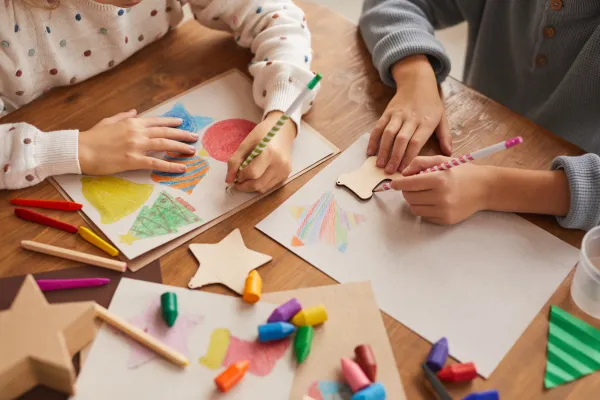
A simple but powerful step is creating a designated “green tray” or sustainability station in the art area, encouraging creating recycled art projects. Not only this sets a grounded rule for everybody to actively pay attention to recycling, this also means children have an open space to reflect on their resource usage.
This may include:
Use one-sided paper for drawing
Offcuts and scrap paper for decorations
Recycled collage materials
Children learn to choose these materials before using new supplies. Over time, this builds conscious decision-making. Not only that, participating in creative activities, children also develop their fine motor skills, through interacting with materials with their hands.
Playing with water is fun, but sometimes a mindful lesson about saving water could help children understand the importance of water conservation.
Talking about reducing water usage could be delivered in an age-appropriate way. For example:
Turning taps off fully
Using half-flush buttons where available
Monitoring water use during play
Discussing why water is precious
These small daily routines help children understand resource management. More importantly, children begin transferring these habits into the home environment, which benefits families too.
Nature-based learning strengthens a child’s connection to the environment. Outdoor playing not only uses play to investigate and explore nature, but it also encourages children to collect their own social experiences to find other ways of being.
Besides outdoor physical games or education, educators can incorporate these activities to conduct nature-based learning, such as:
Gardening experiences
Observing insects and plants
Learning about seasons and weather
Natural loose parts play
When children regularly interact with nature, sustainability becomes meaningful. They begin to understand that caring for the environment is connected to their own wellbeing, and every decision they make contributes significantly to the surrounding environment.
Environmental sustainability doesn’t stop at reduction and reuse, it sometimes involves conscious consumption in everyday decisions. By this, health-conscious parents often look closely at the materials used in early learning environments, such as cleaning products or supplies or even utensils.
Sustainability in childcare also includes:
Using non-toxic cleaning products
Choosing eco-friendly supplies
Selecting durable, long-lasting resources
Actively choosing biodegradable materials for teaching and learning
This approach supports both environmental sustainability and children’s health. Transparency in these practices helps parents feel confident about their childcare choice. It might cost a large amount of money to invest in these durable materials, the impact it brings is unmeasurable.
If sustainability in childcare matters to your family, here are insightful questions you can ask when touring a centre:
How do you teach children about sustainability?
Do you reuse or recycle materials in learning activities?
What cleaning products do you use?
Do children participate in gardening or outdoor learning?
How do you model environmentally responsible practices?
How do you encourage children to discuss sustainability?
A centre that values sustainability should be open and transparent about its approach. Parents are also encouraged to ask questions to have a comprehensive understanding about the practices, which are crucial to form a learning community for early childhood.
At Inspira Kids, sustainability education is integrated into everyday classroom experiences, in which children experience sustainable practices even in daily class preparation. Children are supported to develop practical habits that extend beyond the centre and into family life.
We believe transparency matters. Parents deserve to understand how physical environments, material choices, and daily routines support both wellbeing and environmental responsibility.
Sustainability in childcare should be consistent, meaningful actions that help children grow into mindful, capable individuals. Book a tour with Inspira Kids today to learn more about our sustainable practices in childcare, which are designed thoroughly for the future generations enrolled in.