
Our Insights
Understanding Your Child Better
Our Insights
Understanding Your Child Better
Our Blog
25 Best Outdoor Childcare Ideas for Early Learning
If you have ever wondered what your child is really learning during outdoor play, you are not alone. For many families, time outside can look simple, even unstructured, but it plays a big role in how children grow and learn.
In childcare settings, outdoor play is where children move freely, test their confidence, connect with nature, and learn alongside their peers in ways that feel natural and enjoyable. This article shares 25 practical outdoor childcare ideas that reflect everyday early learning practice.
Physical Development Outdoor Ideas
Supporting movement, coordination, and physical confidence.

1. Obstacle courses using soft equipment
Children move through tunnels, cones, mats, or low balance blocks arranged by educators. These courses encourage whole-body movement and coordination while allowing children to practise navigating space confidently.
Learning focus: Gross motor development, coordination, confidence.
Safety note: Equipment is age-appropriate and set up under close supervision.
2. Balance and stepping pathways
Stepping stones, logs, or marked pathways support children as they practise balance and controlled movement.
Learning focus: Balance, spatial awareness, concentration.
Safety note: Pathways remain low to the ground and are monitored throughout play.
3. Ball rolling and kicking games
Children roll, throw, or gently kick soft balls independently or in small groups.
Learning focus: Hand–eye coordination, movement control, cooperation.
Safety note: Soft balls are used within clearly defined play areas.
4. Riding pathways (bikes, trikes, scooters)
Designated riding tracks allow children to practise pedalling, steering, and stopping in a structured space.
Learning focus: Leg strength, balance, movement confidence.
Safety note: Activities follow centre safety procedures and are closely supervised.
5. Climbing and crawling activities
Low climbing frames, ramps, and crawl-through structures support strength and coordination through varied movement.
Learning focus: Strength, coordination, problem-solving.
Safety note: Heights are kept low, with educators supervising nearby.
6. Gardening tasks that involve movement
Children dig soil, water plants, carry materials, or plant seedlings as part of gardening routines.
Learning focus: Physical strength, responsibility, connection to the natural environment.
Safety note: Child-sized tools are used with educator guidance.
7. Outdoor yoga and stretching
Gentle stretches and simple poses encourage mindful movement and body awareness.
Learning focus: Flexibility, body awareness, self-regulation.
Safety note: Movements are calm and adapted to individual comfort levels.
Nature-Based and Sensory Outdoor Ideas
Encouraging calm exploration and wellbeing through nature.
8. Nature walks within the centre grounds
Children explore garden paths, plants, and outdoor features alongside educators.
Learning focus: Curiosity, observation, early language development.
Safety note: Walks remain within secure centre boundaries.
9. Sensory garden exploration
Children touch leaves, smell herbs, and observe colours and textures in a sensory garden space.
Learning focus: Sensory awareness, emotional regulation.
Safety note: Plants are selected to be non-toxic and safe.
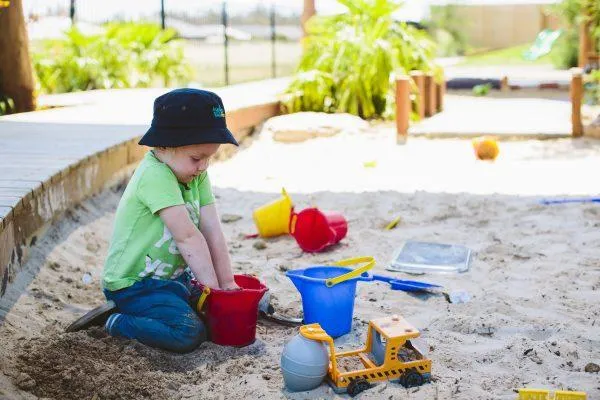
10. Sand and water play stations
Designated sand and water areas allow children to scoop, pour, and experiment freely.
Learning focus: Fine motor skills, problem-solving, sensory exploration.
Safety note: Hygiene routines are followed and supervision is consistent.
11. Exploring natural materials
Loose materials such as sticks, stones, and leaves are used for open-ended exploration.
Learning focus: Creativity, sorting, imaginative thinking.
Safety note: Materials are checked regularly and used appropriately.
12. Listening to outdoor sounds
Children pause to notice sounds such as birds, wind, or rustling leaves.
Learning focus: Listening skills, mindfulness, attention.
Safety note: Activities are calm and educator-guided.
13. Weather-based play (safely managed)
Children experience sun, wind, or light rain when appropriate.
Learning focus: Awareness of the natural environment.
Safety note: Activities follow weather and safety guidelines.
Social and Emotional Outdoor Play Ideas
Building relationships, confidence, and belonging.
14. Group games with simple rules
Games such as follow-the-leader or circle games encourage shared participation.
Learning focus: Turn-taking, cooperation, social interaction.
Safety note: Rules are simple and guided by educators.
15. Cooperative building projects outdoors
Children work together to construct structures using blocks or loose parts.
Learning focus: Teamwork, communication, persistence.
Safety note: Materials are safe and shared fairly.
16. Shared outdoor routines
Children participate in tasks such as watering plants or packing away equipment together.
Learning focus: Responsibility, routine, cooperation.
Safety note: Tasks are age-appropriate and supervised.
17. Turn-taking games in open spaces
Children practise waiting and sharing during group outdoor play.
Learning focus: Self-regulation, patience.
Safety note: Educators support positive interactions.
18. Outdoor role play in small groups
Outdoor role-play areas encourage children to create shared stories and scenarios.
Learning focus: Emotional expression, language development.
Safety note: Play is inclusive and guided.
Creative & Imaginative Outdoor Ideas
Supporting expression, creativity, and communication.
19. Outdoor art using natural materials
Children create artwork using leaves, sticks, sand, or other natural items.
Learning focus: Creativity, fine motor development.
Safety note: Materials are safe and activities are supervised.
20. Music and sound exploration outdoors
Children experiment with rhythm and sound using natural or simple instruments.
Learning focus: Auditory awareness, expressive communication.
Safety note: Noise levels are managed appropriately.
21. Storytelling and reading outside
Educators read stories or encourage children to share their own narratives outdoors.
Learning focus: Language development, imagination.
Safety note: Quiet, comfortable outdoor spaces are selected.
22. Dramatic play spaces outdoors
Outdoor kitchens or role-play areas support imaginative social play.
Learning focus: Social skills, creative thinking.
Safety note: Equipment is child-safe and monitored.
Problem-Solving & Thinking Skills Outdoor Ideas
Encouraging curiosity, thinking, and persistence.
23. Building with loose parts outdoors
Children assemble and balance materials to create structures or designs.
Learning focus: Problem-solving, planning, reasoning.
Safety note: Educators guide safe use of materials.
24. Simple outdoor challenges
Educators pose open-ended questions such as “How can we move this together?”
Learning focus: Critical thinking, collaboration.
Safety note: Challenges are supportive and developmentally appropriate.
25. Nature-based problem-solving tasks
Children explore ways to sort, arrange, or move natural items.
Learning focus: Curiosity, reasoning skills.
Safety note: Tasks are open-ended and supervised.
Explore more: 15 Best Cooking Activities for Toddlers in Childcare
How Inspira Kids Uses Outdoor Activities for Early Learning
At Inspira Kids, outdoor activities are an intentional part of the daily learning program rather than a break from learning. Educators plan outdoor experiences to support children’s development through movement, exploration, and interaction with the environment.
Outdoor learning is educator-guided and reflects children’s developmental stages, interests, and individual needs. Educators observe how children engage outdoors and use these observations to support learning in meaningful and age-appropriate ways.
Outdoor experiences align with the principles of the Early Years Learning Framework (EYLF), supporting learning through play, wellbeing, and a sense of belonging. Safety and wellbeing remain a priority, with clear routines, consistent supervision, and environments designed to help children feel secure and confident while learning outdoors.

Final Thoughts
Outdoor childcare ideas support early learning when they are thoughtfully planned and guided by educators. In early childhood settings, outdoor play is not separate from learning. It is one of the ways children develop physical skills, thinking abilities, social connections, and emotional confidence through everyday experiences.
A well-structured outdoor environment, combined with consistent supervision, allows children to explore safely while building independence and curiosity. Each child is supported to participate at their own pace, allowing learning to unfold naturally through movement, nature, and play.
Understanding how outdoor activities support early learning can help families feel confident in the value of outdoor experiences within childcare. When learning, safety, and wellbeing are carefully balanced, outdoor play becomes a meaningful part of a child’s early learning journey.