Our Insights
Understanding Your Child Better
Our Insights
Understanding Your Child Better
Our Blog

Try These Five Amazing Arts And Crafts Activities For Children In Our Classroom
Try These Five Amazing Craft Activities For Children In Our Classroom
Arts and crafts can look messy on the surface: a bit of paint here, some glue there. But in an early learning classroom, they’re much more than cute take-home artwork.
Craft activities for children bring more benefits to children overall: we’re supporting how they think, move, communicate, and connect with others. Along the way, we might find it quite messy, but it’s often where the best learning happens.
Below you’ll find five easy, classroom-friendly ideas that suit a Reggio Emilia–inspired approach: materials-rich and focus on curiosity.
Why Arts And Crafts Matter In The Early Years
In the preschool and toddler years (roughly 0–5), children learn best through doing. Arts and crafts invite hands-on exploration that supports multiple areas of development at once.
Fine motor development: Tearing paper, squeezing glue, holding a brush, pinching small items. all help strengthen hand muscles needed later for writing and self-help skills.
Sensory learning: Texture, temperature, resistance, wet/dry materials and smells help children identify elements in the world.
Language and social skills: Children often narrate what they’re making, ask for materials, explain ideas, and learn new words naturally.
Creativity and flexible thinking: Open-ended art encourages children to try, change direction, and explore “what if?” concepts, which sometimes can lead to imagination development.
Confidence and persistence: When there’s no single “right” outcome, children can take safe risks and practise sticking with a task.
Emotional well-being: Repetitive motions (like brush strokes or rolling playdough) can be calming and support self-regulation.
In Australia, this kind of play-based learning aligns beautifully with the EYLF (Early Years Learning Framework), especially the focus on wellbeing, communication, identity, and confident learning through hands-on experiences.
Do Crafts Only Rely On Paper, Cardboard?
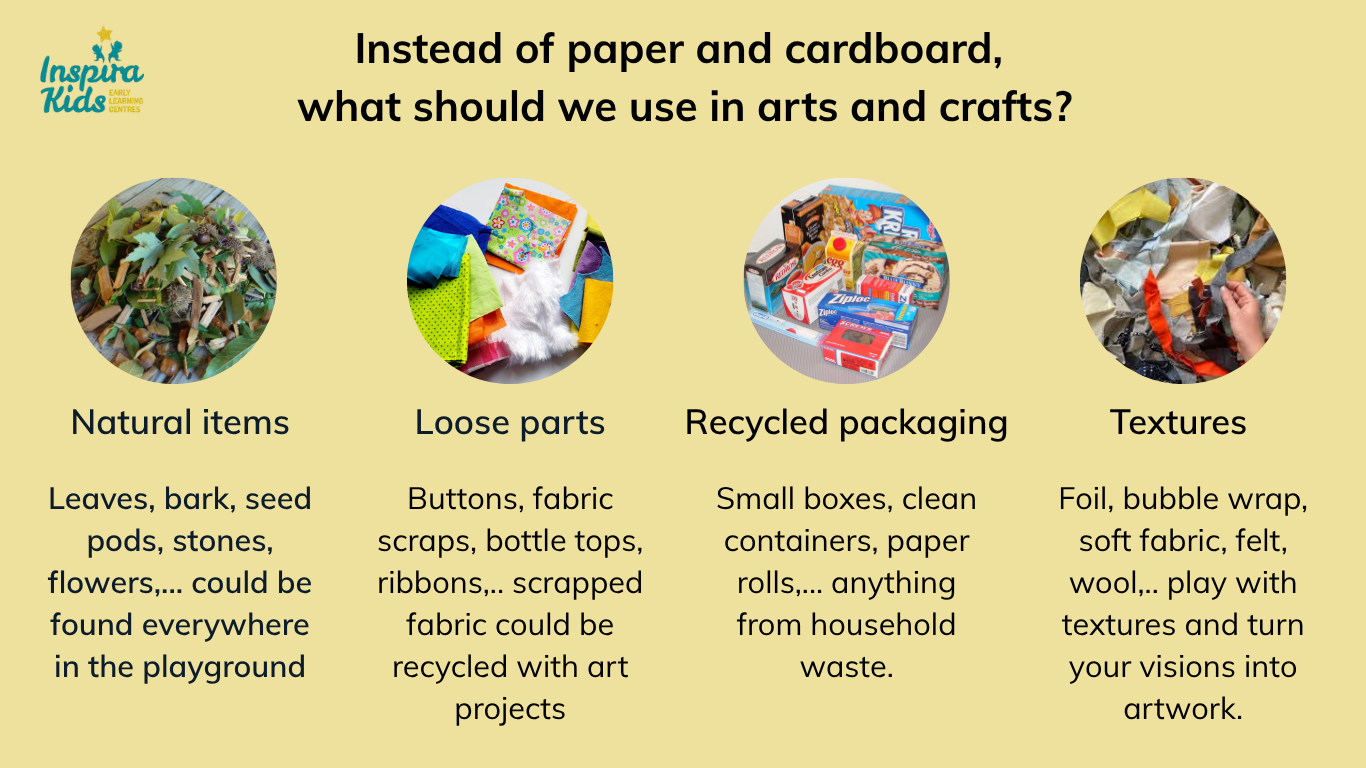
Traditional craft supplies are great, but children don’t have to create only with paper, cardboard. If we rely on traditional materials, we unintentionally limit children’s creativity, hindering their full potential.
Some of the most engaging craft activities for children use materials they’re naturally drawn to, such as:
Natural items (leaves, bark, seed pods, stones, flowers)
Loose parts (buttons, fabric scraps, bottle tops, ribbons)
Recycled packaging (small boxes, clean containers, paper rolls)
Textures (foil, bubble wrap, soft fabric, felt, wool)
Different materials potentially bring different ideas, and creating arts and crafts with limitless possibilities is an ideal way to let children’ think and turn their visions into artwork.
Five Amazing Arts And Crafts Activities To Try
Each activity below can be adjusted for different ages, from younger toddlers through to preschoolers. With open-spaced childcare, it is possible to let children have outdoor learning sessions every once in a while.
Before conducting activities, teachers don’t have to reveal what game it is for today’s session. Sometimes, letting children guess what they are going to learn or do can help them develop cognitive skills, with thinking and linking information to reasonable answers.
1. Nature Collage Creations
A nature collage turns a simple outdoor walk into a creative, mindful experience, and it’s a great way to combine movement with art.
What you’ll need
A collection basket or paper bags
Cardboard or thick paper bases
Glue sticks and/or child-safe PVA (with brushes)
Optional: contact paper (sticky side up) for an easier, no-glue version
How to set it up
Go on a short nature walk in your outdoor area (or a nearby safe space).
Invite children to collect interesting items: leaves, petals, twigs, feathers (if appropriate), seed pods.
Back inside, offer collage bases and let children arrange materials freely.
Tips to conduct this activities:
Teachers can show some examples of how collages are made using similar materials. Once the class is over, teachers can turn classrooms into small exhibitions.
2. Handprint And Finger Painting Art
Finger painting is a classic for a reason: it’s sensory-rich, expressive, and fantastic for developing control in hands and fingers.
What you’ll need
Washable, non-toxic paint
Large paper
Smocks, wipes, and a water tub for quick clean-ups
Optional: rollers, sponges, cotton buds, textured stampers
How to run it
Offer 2–3 paint colours at a time (less overwhelm, more focus).
Invite children to explore with hands, fingertips, and simple tools.
Some tips for teachers
Use gentle language that focuses on the process: “You’re making swirls,” “That feels slippery,” “You mixed colours.” By this, we are taking advantage of the sensitivity children feel with our instructions, therefore they can learn and form definitions for different activities.
3. Recycled Materials Craft Challenge
This one is a classroom favourite because it feels innovative, resourceful, which is very aligned with a Reggio-inspired environment.
What you’ll need
A “maker” basket of clean recyclables: small boxes, paper rolls, lids, egg cartons
Masking tape, child-safe scissors, glue
Optional: string, paper scraps, stickers, markers
How to run it
Present the recycled materials as “treasures” children can choose from.
Offer a simple invitation: “What can you build today?”
Support children to plan, test, and adjust as they create.
Educator language that helps
“Tell me about your idea.”
“What could you try next?”
“How will you make it stand up?”

4. Story-Based Art Projects
This is a beautiful way to combine literacy with art, and it works well in both childcare and preschool/kindergarten-style programs.
What you’ll need
A favourite picture book
Drawing tools, collage materials, paint, or playdough
Optional: photos of the story setting, character puppets, or sensory props
How to run it
Read a story together (or revisit one children already love).
Invite children to respond through art:
draw a character
create a setting collage
paint the “mood” of a scene
build something from the story using recyclables
Display artwork with children’s words beside it (a simple form of documentation).
Learning module you’re supporting
Language development, comprehension, imagination, and confidence in sharing ideas.
5. Collaborative Mural Painting
A shared mural supports belonging and teamwork and it can become a living piece of your classroom environment.
What you’ll need
A large roll of paper (or cardboard sheets joined together)
Washable paint, brushes, rollers, trays
Optional: music for atmosphere, photos of murals/art for inspiration
How to set it up
Tape paper to a wall (at child height) or spread it on the floor outdoors.
Offer a few colours at a time and allow children to paint freely.
Encourage collaboration without directing the outcome.
How to help children learn cooperation?
Educators can introduce different sheets of paper for different teams, after they read the same stories. By that, children can plan and communicate together to consider their approach to create desired artwork.
FAQs
1. How often should we do arts and crafts in childcare?
Little and often works well. Short, regular opportunities (even 10–20 minutes) can be more effective than a big craft day once a week.
2. What if a child doesn’t want to join in?
That’s okay. Offer a gentle invitation, keep materials visible, and allow watching. Many children join when they feel ready.
3. How do we avoid crafts that all look the same?
Choose open-ended materials and remove the “model to copy”. Focus on prompts (“What can you make with these?”) instead of templates.
4. Is messy play really worth it?
Yes, when it’s well set up. Messy, hands-on experiences support sensory processing, motor skills, and creativity in ways worksheets never can.
5. Can parents apply the same ideas at home?
Absolutely. Parents can apply these ideas at home to teach children about nature, as well as have family time to communicate, foster a healthy relationship with children.
6. Should educators interfere when children have troubles?
Yes, but not until children ask for assistance. Solving ad-hoc problems also helps toddlers deal with sudden situations, preparing them with rational approach and problem solving skills.